Knee osteoarthritis (hereafter, knee OA) is a condition in which biological factors (such as aging) and biomechanical factors (such as loading and external mechanical stress) lead to structural changes in the cartilage and bone of the knee joint.
Previous studies have shown that the prevalence of knee OA is particularly high among older adults in Japan (Muraki S, Oka H, Akune T, et al., Osteoarthritis Cartilage, 2009).
This raises an important question:
If we can reduce mechanical stress on the knee, is it possible to reduce pain or even slow the progression of knee OA?
That’s the topic I’d like to explore today.
What Is Mechanical Stress on the Knee?
Mechanical stress refers to forces such as tension, compression, and twisting applied to the joint.
Mechanical stress on the knee can come from several sources:
- Body weight
- Lifestyle-related background factors
- Physical structure (anatomical factors)
- Abnormal or inefficient movement patterns (movement-related factors)
These four factors overlap and increase the load on the knee, contributing to the onset and progression of knee OA.
A Representative Mechanical Stress: Abnormal Movement Patterns
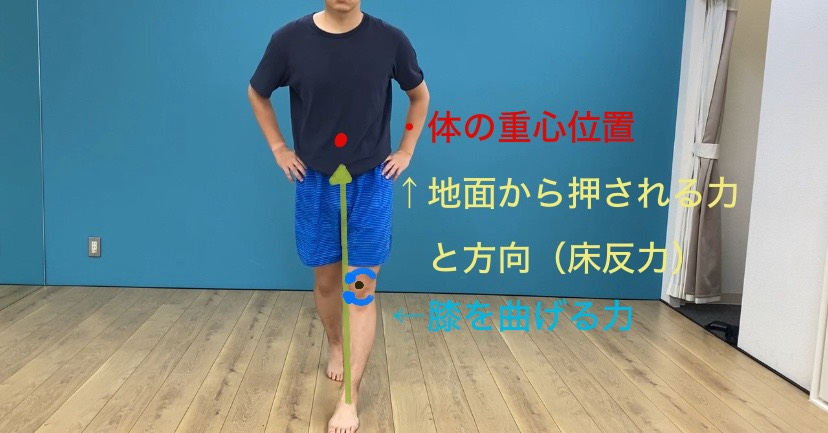
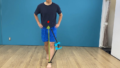
The photo below shows me while walking.
Whether we are standing or walking, a force called the ground reaction force acts upward from the floor toward our body’s center of mass (red dot).
To put it simply, imagine doing a handstand.
Your arms eventually get overwhelmed by the force pushing back from the floor—that force is the ground reaction force.
When doing a handstand, your arms work hard to maintain posture and balance against that force.
Now, what happens when the distance between the green arrow (ground reaction force line) and the knee (black dot) becomes larger?
Imagine the bent point on the black line as the knee.
The farther the knee is positioned away from the green line, the more the knee is pushed into a “knock-kneed” direction, increasing stress on the joint.
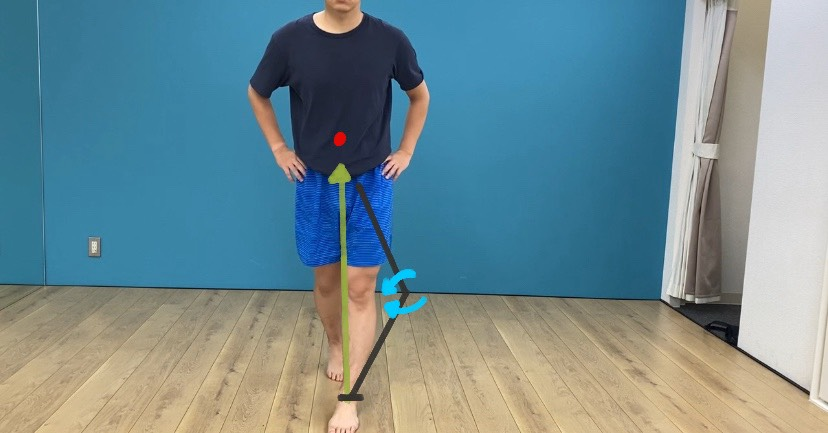
This inward-bending force is called the external knee adduction moment, commonly known as KAM.
Why KAM Matters
The degree of this “inward bend” (KAM) is considered an indicator of medial knee loading and has been associated with OA severity and progression risk
(Miyazaki et al., Ann Rheum Dis., 2002;
Andriacchi et al., Ann Biomed Eng., 2004;
Mündermann et al., Arthritis Rheum., 2005;
Kuroyanagi et al., Knee, 2012;
Mochizuki et al., KSSTA, 2022).
By now, you can probably imagine why preventing this “knock-knee” force is so important.
Next Time…
In the next article, I’ll talk about how the body resists KAM and the characteristic walking patterns seen in people with knee OA.
Stay tuned for Part 2 !